
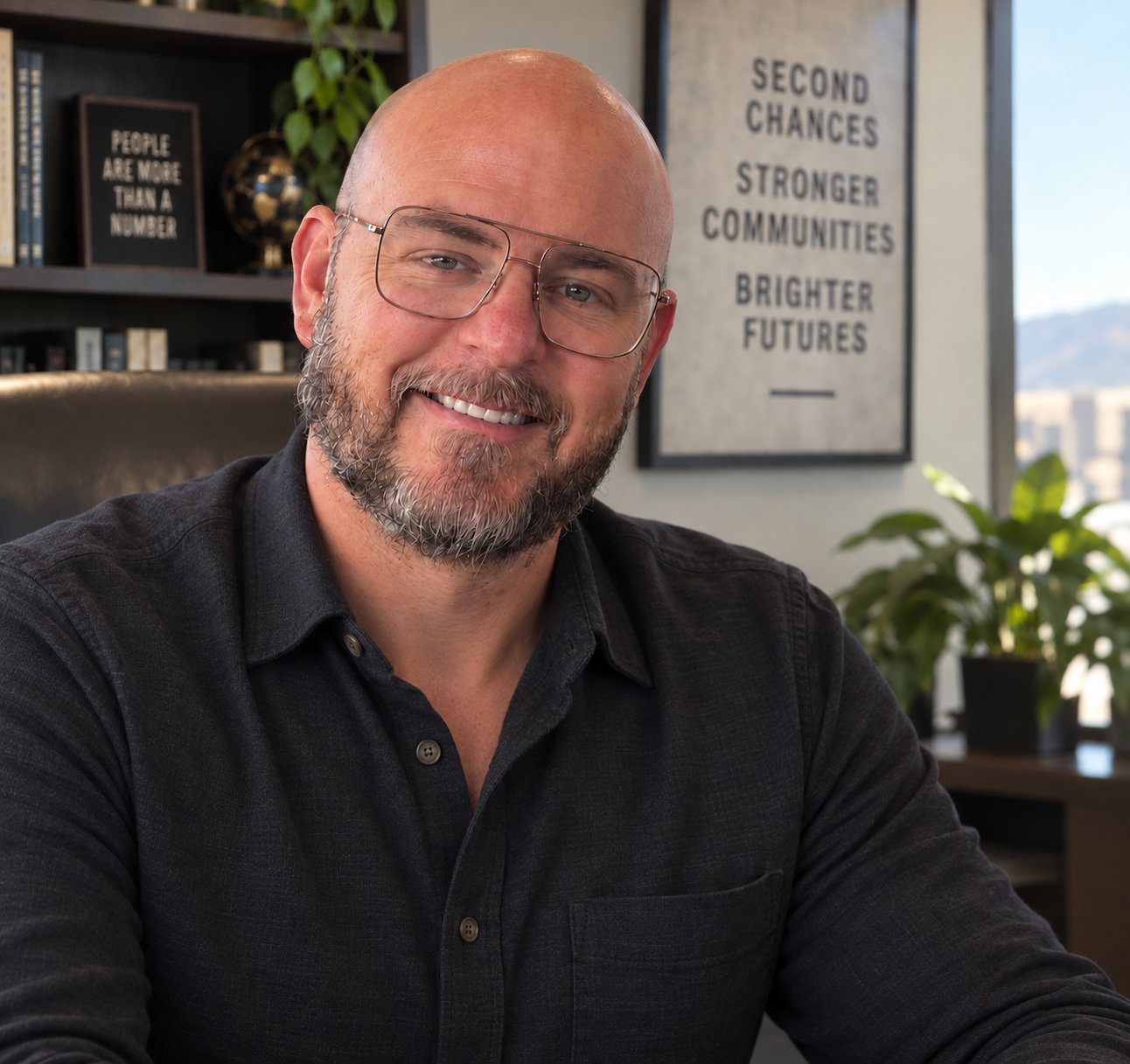
MEET THE FOUNDER
Judah Hosanna
Founder & CEO
I was 18 years old when I received my number.
I was young, caught up in drugs, gangs, and violence, and trying to figure out a life I had never really been shown how to live.
My father struggled with methamphetamine addiction. My mother was there, but somehow she was never really around. She wasn't absent. She was just... gone. It's difficult to explain any other way.
The truth is, I was on my own.
I grew up without the guidance, stability, and role models I needed, and by the time I was becoming a man, I was trying to figure out what being a man even meant.
None of that excuses the choices I made.
I made choices that I'm not proud of, choices that cost me years of my life in prison. They were mine, and I had to live with their consequences.
But those choices didn't happen in a vacuum. There was a kid before there was an inmate. And understanding where that kid came from is part of understanding the man he eventually became.
For all those years in prison, all I wanted was a small taste of freedom.
I remember the days I would stand in front of a window no larger than a cereal box and just dream. There wasn't much to see. Mostly barbed wire and clouds.
But at that point in my life, it was enough for me.
Those clouds were outside. They could go somewhere I couldn't. And standing there looking through that little window, I would imagine what it would feel like when I could finally walk outside and there was nothing between me and the rest of the world.
I thought about freedom for years.
I dreamed about it.
I waited for it.
And then it finally came.
But the hardest days of my life weren't the ones I spent locked in a cage.
They were the ones I experienced after I was released.
I was dropped off at a Greyhound bus station in a town I didn't know, thousands of miles from anyone I had ever known. I had no phone, no money, no identification, no resources, no family waiting for me, and nowhere to go.
I walked out of prison directly into homelessness.
I slept on the street. I remember digging through trash cans looking for something to eat because I genuinely didn't know where my next meal would come from.
Eventually, I became so hungry, so lonely, and so broken that the one place I had spent years dreaming about getting away from became the only beacon of hope I could see for myself.
Prison.
If I could just get back to prison, I knew I would have somewhere to sleep. I knew there would be a roof over my head. And no matter how bad the food was, I knew there would be something to eat.
I had spent years standing in front of that tiny window dreaming about the day I would finally be free.
Now I was free, and I was dreaming about going back.
That realization has never left me.
Hunger doesn't care about your criminal record. Loneliness doesn't ask what mistakes you've made. Fear doesn't disappear because someone believes you brought your circumstances upon yourself.
Those things simply hurt.
And I was hurting.
Underneath the conviction, the prison sentence, and the inmate number was the same thing underneath every one of us:
A human being who needed help.
But my truth, and my reality, was that no one was coming.
No one showed up.
There was no person waiting to pull me out of the situation I was in. No organization appeared with the answers. No one came along to tell me what to do next.
I was on my own.
So I had to figure out how to survive.
There is one night from that time that I remember in detail, almost like it happened yesterday.
It was a cold, rainy night in the middle of winter. I had found an old warehouse where furniture was reupholstered, and behind the building was the only awning I could find anywhere on the block. After the business closed, I would hop the fence so I could get underneath it and have at least some protection from the rain.
By then, I had gotten into the habit of collecting old newspapers and scraps of paper I found in the trash. At night, I would use them to make a small fire just to keep myself warm.
I carried them in a plastic shopping bag I had also found in the trash.
That night, sitting behind that warehouse, I reached into the bag and pulled out one of the newspapers I had collected.
I was getting ready to burn it.
But when I opened it, an advertisement caught my eye. It was looking for people willing to travel the country selling books and magazines door to door.
I didn't have a phone. I didn't even have money to make a call.
So I ripped the ad out of the newspaper and held onto it.
I couldn't have known it then, but that piece of newspaper I had collected to help keep myself warm was about to change the trajectory of my life.
The next day, I found a phone and made a collect call to the number printed on that little piece of paper.
To my amazement, they accepted the call.
And by the next day, I was on a bus to Baltimore. No interview, no background check, no need for identification. Just a bus ticket prepaid and waiting for me at the same Greyhound bus station that the corrections officers had dropped me at when I was released from prison.
When I arrived, the company provided a rundown motel room and a small daily meal allowance. I found myself surrounded by people from all over the country, many of whom seemed to have come from difficult circumstances of their own.
It wasn't glamorous. It wasn't comfortable. And I didn't really know what I had gotten myself into.
But I had a roof over my head. I had a shower. And I knew I would have something to eat.
The work was entirely commission-based.
Every day, I went door to door trying to sell books and magazines. I knocked on door after door and heard no after no. People turned me away. Doors closed in my face.
But then it happened. After weeks of this depressing cycle, someone finally said yes.
I made my first sale.
I distinctly remember standing there in awe as I handed over the subscription paperwork to what appeared to be a single mother of 3 very young children, all of whom had followed her to the door. She filled out the paperwork, handed it back, and said “Thank you very much, sir. Have a blessed day.” I waved with a smile as she closed the door, not really able to find any words as I walked away. At the end of the woman’s driveway, right where it met the sidewalk, there was an old sign faced in a way that a passerby could read. It said, “Know Your Worth.” I stood there at that sign for what seemed like an eternity and just cried. As the tears came, my emotions surfaced in a way that I had not experienced in a very long time. When I had walked up to that house, the weight of the world, along with everything I had been through, was firmly planted on my shoulders, literally crushing me. But as I left that house and stood there in front of that sign reflecting on everything, I felt a small sliver of hope, and my tears turned to a smile.
That woman couldn't possibly have known what her yes meant to me. She didn't know that not long before, I had been digging through trash looking for food. She didn't know where I had been sleeping. She didn't know how close I had come to believing I wasn't going to make it.
To her, it was just a purchase.
To me, it was a beginning.
For the first time since my release, I had earned something for myself. It wasn't given to me. I had knocked on that door, heard all those no's, kept going, and finally after all my heart ache and after all my hard work, I earned my first yes.
I remember thinking:
It’s possible...
And the fact is, sometimes all you need is the possibility
That first yes changed me. But more importantly, it changed the way I thought about my own capabilities. I practiced day and night how to talk to people effectively and began incorporating it in my sales pitch until I had mastered the art.
For the next year, I traveled across the country with that company, working and saving as much as I could until I finally made it home to San Diego.
I had survived the street. I had worked. I had saved money. I was ready to start building a life.
Then I discovered that wanting to move forward didn't mean everyone was willing to let me.
Landlords repeatedly refused to rent to me because I was a felon. I had the money to pay rent, but my record was enough to close the door. Employers consistently denied me, and without shame made it a point to let me know they didn’t hire convicts.
For almost a year, I moved from motel to motel until an older couple in Chula Vista finally gave me a chance.
They rented me a tiny room behind their home. Inside was a bed, a sink, a toilet, and a small nightstand.
It wasn't much.
But after having nowhere to belong, they had given me something most of us hope we'll never have to live without.
A place to call home.
From there, I spent mornings outside Home Depot hoping someone would give me work for the day. If I wasn't given the opportunity to work, I would spend my time walking past open construction sites looking for a chance to hire on. I did this all while consistently trying desperately to get hired by anyone willing to let me fill out an application.
Eventually, after what seemed like an eternity caught in vicious cycle of defeat, I was hired by a large corporate building contractor that needed a sales agent.
It was the opportunity that gave me the stability and consistency I needed to make lasting change.
For the first time in my life, I had a home. I had a job, I had a paycheck to support myself. But most importantly, it was the first time I had the opportunity to work on myself in the way that would change my life forever.
Education.
I began attending night school. And slowly, as time progressed, my education produced new opportunities.
One opportunity became another. And after enough hard work I was able to build a life I was proud of.
Over the years, I built a career. I pursued my education and earned multiple college degrees. I built a loving family and raised amazing children. And after years of building a stable life and giving back to my community, something happened that I never thought possible.
Because I had been a first-time offender, successfully completed my sentence and probation, and met the court’s requirement of giving back to the community I had wronged, I became eligible to have my conviction overturned and my record sealed.
My life today looks nothing like the life of that young man sleeping on the street.
But none of those accomplishments erase who he was.
They show who he was capable of becoming.
That's something I wish more people understood about those returning home from incarceration.
We use words like felon, offender, inmate, and convict so easily that sometimes we forget what all of those words are describing.
A person.
Someone who gets hungry.
Someone who gets scared.
Someone who wants to be loved.
Someone who wants somewhere to belong.
Someone who may have made serious mistakes but is still genuinely capable of making different choices.
My past is part of my story. I don't hide from it, and I don't ask anyone to excuse it.
But it was never all that I was.
And neither is anyone else's.
I created Names Over Numbers Foundation because I know what it feels like to reach the lowest point of your life and realize there is nobody there to help you stand back up.
I had been convicted.
I had been incarcerated.
I had been given a number.
But I was still human.
I still needed food.
I still needed somewhere to sleep.
I still needed an opportunity.
I still needed someone.
Sometimes I think about what I would do if I could go back and see that younger version of myself sleeping on the street.
And the truth is, I wouldn't change what he went through.
As painful as it would be to watch him struggle, those experiences helped shape the man and father I became. Without them, I may never have understood what it means to meet another person at the lowest point of their life and truly understand the pain behind their eyes.
But if I was there today watching that young man digging through a trash can because he was hungry, it would break my heart.
Because I know something about him that nobody else overlooking this man in need could have known.
I know who he becomes.
I know that young man will someday become a father.
I know he'll become a college graduate.
I know he'll dedicate his very existence to the service of others.
He'll become someone his 18-year-old self couldn't possibly imagine.
And that's what I think about when I see someone struggling today.
We don't know who that person will become.
We don't know whose parent they will be. Whose neighbor. Whose friend. Whose employee. Whose mentor. Or whose helping hand they may become when someone else is struggling someday.
All we know is the person standing in front of us right now.
And sometimes, that's all we should need to know.
Because before someone is a conviction, a criminal record, an inmate number, or a statistic, they are something far more important.
They are human.
I can't go back and be there for the young man I once was.
But Names Over Numbers Foundation can be there for the next person that needs help.
I built this foundation for all those who have not.
I built this foundation for all those seeking a better life.
I built this foundation for all those reaching for a second chance.
But most of all, I built this foundation to be a beacon of hope and to show the world that names always belong above numbers.
I am Judah Hosanna
And this is Names Over Numbers Foundation